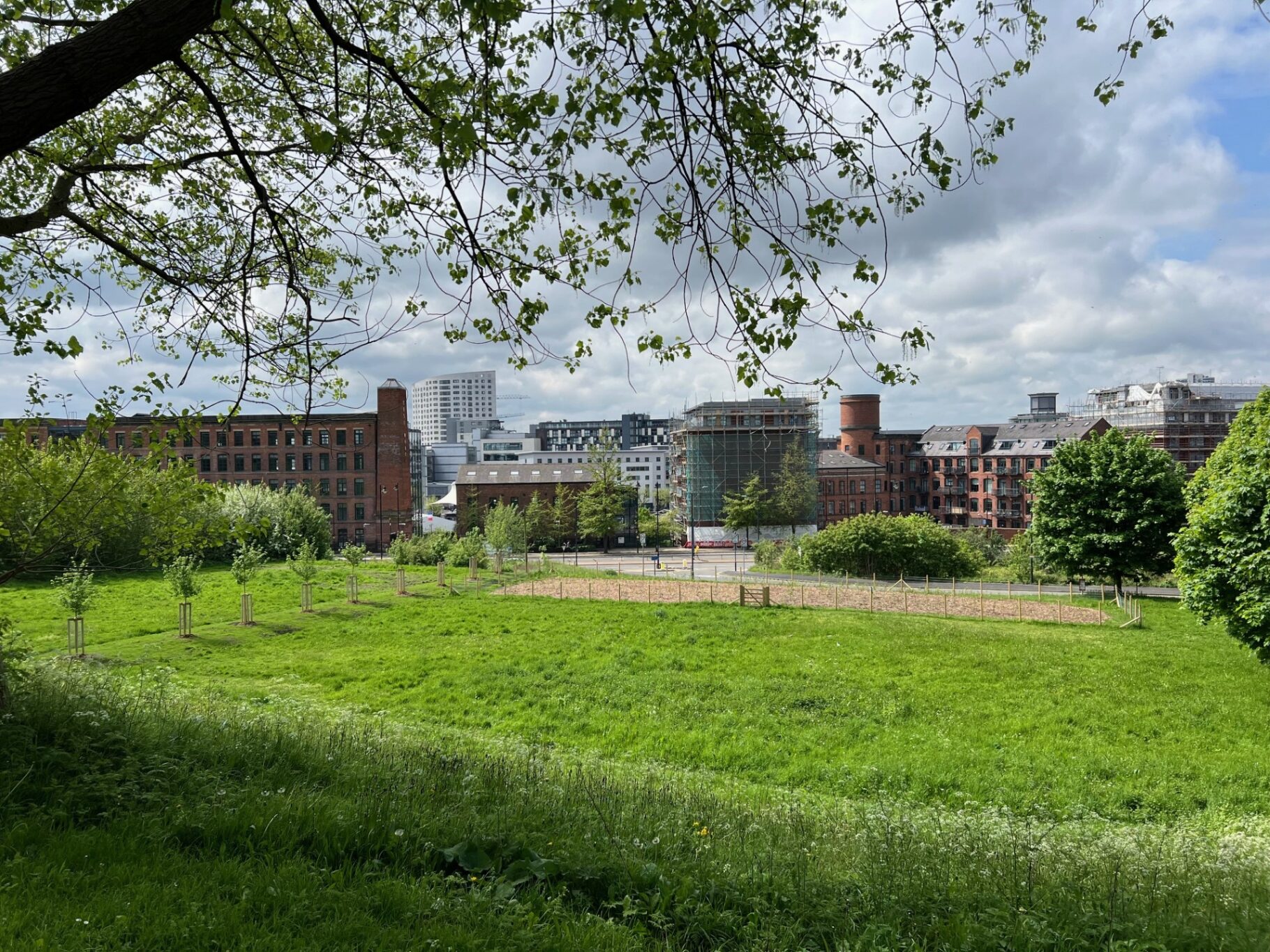
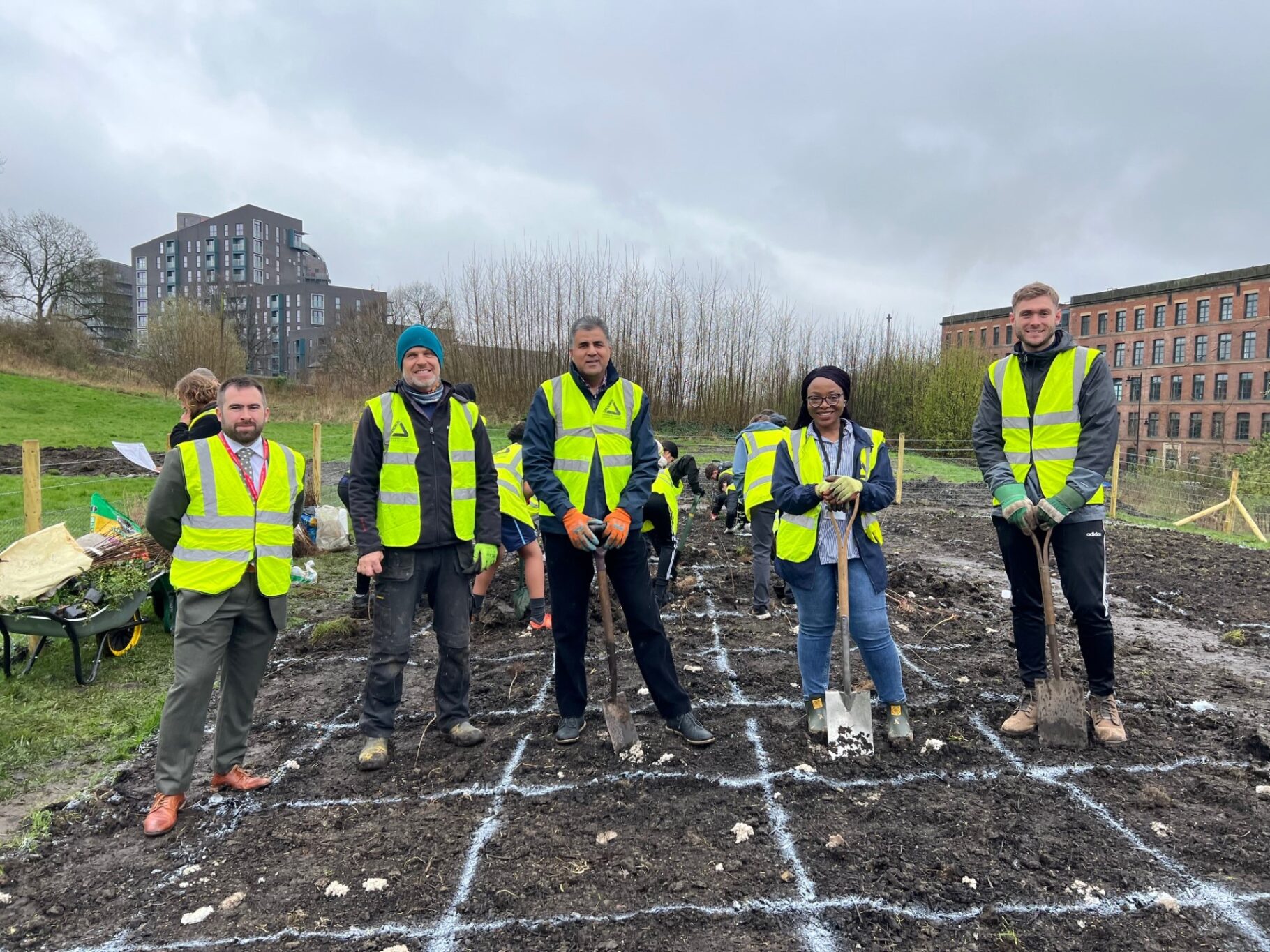
We planted 1,200 trees at Bow Street in Leeds over two days with help from Mount St Mary’s Catholic High School, Richmond Hill Academy, Caval volunteers, a White Rose Forest member and Saxton Apartments Residents volunteers.
In March we began planting Leeds’s first Micro Wood, inspired by the Miyawaki-style of forest. The concept came from Japan in the late 70s/early 80s and was named after Japanese botanist Akira Miyawaki. Miyawaki was trying to mimic the conditions of an ancient forest, creating something that would grow ten times faster than a normal woodland. Trees are planted tightly together to encourage competition and creates a fast-growing woodland. Our Micro Wood, which is Leeds’ first, will provide a noise and pollution barrier intercepting and dispersing harmful, airborne, ultrafine particulate matter blowing across the site form the adjacent A61 dual carriageway.
Before planting, the ground was intensively prepared by digging down one metre, bringing in soil ameliorant, some green waste and well-rotted farm manure to help create the rich, loose, friable growing conditions.
We planted 1,200 trees over two days with help from Mount St Mary’s Catholic High School, Richmond Hill Academy, Caval volunteers, a White Rose Forest member and Saxton Apartments Residents volunteers. Everyone really enjoyed getting stuck in. Our volunteers and the pupils, got a lot out of it and we’ve hopefully helped attract some custodians for the forest as it grows in the next few years.
The tree and shrub species are of local provenance and locally sourced from Leeds’s own Arium nursery. The 12 native species are planted on a grid pattern and they’re all the trees that would have grown here in Leeds before humans arrived. After three years, you don’t have to do any maintenance; It looks after itself because the chosen species have evolved over millennia to grow symbiotically with each other which helps promote fast growth.
We’re working with Leeds University Air Quality Department and will be installing their Purple Air sensors, in front and behind the woodland and seeing what effect this heavily dense planting will do in terms of air quality from the busy A61. We’re also working with the schools to do a bit of citizen science, monitor the growth and carry out light maintenance of the space.
Interpretation panels will be installed shortly as well as a couple of picnic benches and a circular footpath to make this is a nicer space for residents to use surrounding it to come and relax once it’s got established.